“The roots of education are bitter, but the fruit is sweet.’’ Aristotle
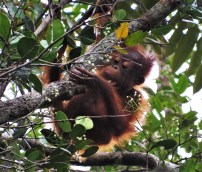
Jane examines flowers
Trying to impress upon children the value of going to school can indeed be a bitter affair. It’s like telling a young orangutan to choose a very prickly, sour, and hard-to-eat fruit over a delicious, tender, and bountiful flower because, far in the future, the fruit-filled orangutan will be healthier and heartier than the one who subsisted on the beautiful, delicate, but nutrient-poor flower. Likewise, good education is a time- and resource-intensive investment, but one which has been proven time and again to pay off in the long-run. In the rural villages of Kalimantan, Indonesia, would-be students are the ones who will soon be entrusted with the stewardship of some of the world’s most endangered tropical forests ecosystems.
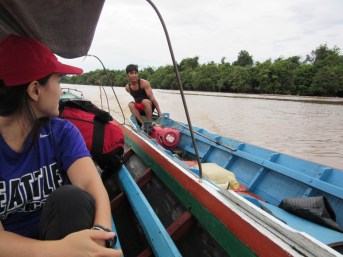
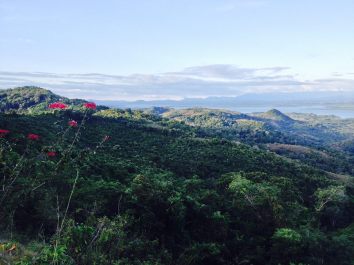
JOURNEYS TO JUNGLES: The village of Tuanan is a half-day journey from Palangkaraya, the capitol city of Indonesian Borneo. A two hour drive first whisks you from sprawling expanses of development out into the even more expansive countryside. Both landscapes bear the heavy hand of human development, with single spindly trees rising from the flat, scrubby acres of cleared peatland that make up so much of central Kalimantan. Paved road abruptly gives way to a rough-hewn dirt path — an outlet for logging trucks and their cargo – which leads to a small boat launch site along the Kapuas River. From there, another two-hour ride brings you to the white, sandy shores of Tuanan. Albeit dependent upon the prompt arrival and subsequent functionality of both motored vehicles involved, the length and difficulty of the journey isn’t too bad as far as treks to field stations go.
The trip to Tuanan is almost completely engine powered. But when your boat’s motor dies halfway up the Kapuas river, you’ll have to find someone to tow you the rest of the way.To get to my research site in Madagascar, one had to hike for three hours through mangrove swamp, paddle by dug-out canoe across a large stretch of bay, then hike another two hours up a mountain carrying all gear and supplies on-head!
Nonetheless, researchers at Tuanan infrequently leave the forest, breaking up 2-3 month stints at the field station with week-long visits to the city. What makes the journey so prohibitive is not its length or duress but rather its cost. The price of gasoline is high and there are very few fuel-efficient motors on hand in Kalimantan. The local people of the Tuanan village, as you might imagine, are even less able to fund such trips, reserving this kind of travel for holidays or very special occasions.
This slideshow requires JavaScript.
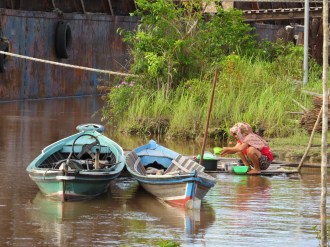
UNIQUELY INSULATED… My first thought is to call Tuanan and all in it ‘isolated’ but that’s not quite right. The people of Tuanan and nearby villages are not without connection to the outside world or its resources, especially as they are frequented by large barges carrying everything from clothing and cakes to tools and toys. These days, many even have cell towers and hence access to news and digital communication. Rather, the isolation is one-directional; Things come in far more often than they go out. ‘Insular’ is a better way to describe the lives of those living at Tuanan and the nearby villages. For the most part, jobs, relationships, and day-to-day lives are restricted to the village, river, and surrounding forest. And, while Tuanan is in most ways identical to the other riverside villages, it has a unique distinction: it began artificially, created as a base for the Tuanan Orangutan Research Project. It is a community comprised of people working for and associated with TORP.
THE UPS AND DOWNS OF LIFE AT TUANAN: There are benefits as well as disadvantages associated with this distinction. On one hand, being connected with TORP – a high-level, multi-national research effort — has afforded the Tuanan village many additional resources that most other rural Indonesians don’t have access to. This includes everything from solar power and IPads to a constant stream of ‘bules’ (foreigners) cycling through their lives (which could also be seen as a con but which, given how often I found that I was a source of good-natured curiosity and amusement, I’ll list as a pro).
One of the most glaring negatives, however, is that, having been formed and existing for the sole purpose of supporting the research project, the Tunanan village is even smaller than most. All of those insular problems are compounded because the community doesn’t attract or support anyone/anything beyond what the research project requires; there are no markets or restaurants, no mosques or temples. The closest things they have to businesses are families who buy in bulk from the supply boats and take it upon themselves to run small convenience stores out of their houses.
Though most are still young, all of Tuanan’s current field assistants have lived and worked at Tuanan for many years. Highly knowledgeable and rigorously trained, they are the backbone of the project’s research component. Likewise, their families are the backbone of the Tuanan community. Until now, the various shortcomings of Tuanan village life have not overshadowed the benefits they glean working for the project, where each is an integral team member. But, as their children grow, there is one resource Tuanan lacks that is driving some to consider leaving.
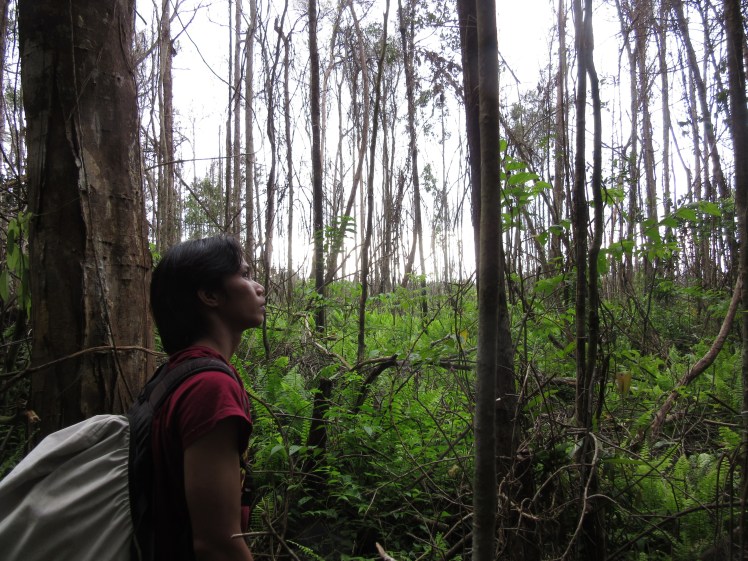
Field Assistant Idun on an orangutan follow near the ‘burned area’ of the Tuanan forest.
WHY TUANAN NEEDS A BETTER SCHOOL: “Education is very important for the future of our children… If the school at Tuanan is not good, I will have to move.” – Idun
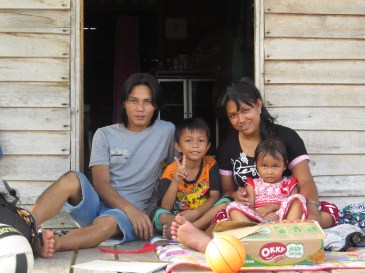
Idun and his family in the Tuanan Village
Who better to understand the value of good education than the man who went from a career logging (like almost all rural Dayak men in the later part of the 20th century) to one spent working alongside countless highly-educated researchers and students from all over the world? Idun, one of Tuanan’s six field assistants, experienced this shift but is now watching his two children, Nova and Irwan, grow up with far from consistent education.
At the time of its creation, the village of Tuanan was constructed with a school building, the site of multiple researcher-taught environmental education initiatives. Continuous and effective fundamental education, however, has been lackingdue to inadequate supplies and transient teachers. The closest alternative school is a long and expensive boat ride away.
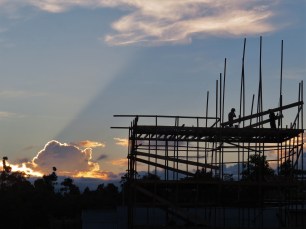
What Tuanan needs now are the funds to build an addition onto the current school building – providing permanent living quarters for the school teacher (who currently commutes from a distant village) and or her family. Additionally, basic supplies such as textbooks, pencils, and school clothes–uniforms are standard in Indonesia–are desperately needed by these children. During my year at Tuanan, I’d bring paper and colored pencils down to the village on my free days to draw with the kids. We’d take over an entire porch and draw for hours. These sessions always ended with shy requests to take an extra sheet of paper to practice writing at home. Bettering the school at Tuanan means more than simply providing basic education to a small group of children: with a better school, the Tuanan research project gets to keep essential members like Idun, saving it the extensive resources and time required to find and train new field assistants. The structural integrity of the community is also preserved. Tuanan’s village children, who are in a unique position to absorb real appreciation and respect for the forest and orangutans, will get the basic education that all children should be entitled to.
 THE UPS AND DOWNS OF LIFE AT TUANAN: There are benefits as well as disadvantages associated with this distinction. On one hand, being connected with TORP – a high-level, multi-national research effort — has afforded the Tuanan village many additional resources that most other rural Indonesians don’t have access to. This includes everything from solar power and IPads to a constant stream of ‘bules’ (foreigners) cycling through their lives (which could also be seen as a con but which, given how often I found that I was a source of good-natured curiosity and amusement, I’ll list as a pro).
 One of the most glaring negatives, however, is that, having been formed and existing for the sole purpose of supporting the research project, the Tunanan village is even smaller than most. All of those insular problems are compounded because the community doesn’t attract or support anyone/anything beyond what the research project requires; there are no markets or restaurants, no mosques or temples. The closest things they have to businesses are families who buy in bulk from the supply boats and take it upon themselves to run small convenience stores out of their houses.