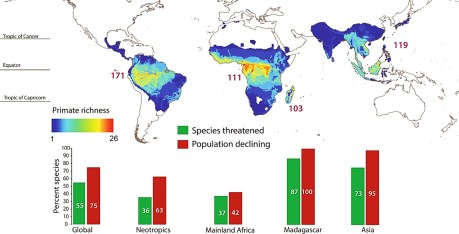
World primate range (Fig 1 from Estrada et al. 2017)
Over the last year, a slew of both scientific (S) and popular (P) literature has been published concerning primates and primate conservation. By amassing it and pulling out the key ideas, it is easy to see the recurrent ‘big picture’ and an important takeaway message that holds major implications for Tuanan and its orangutans!
Below are links to some of the most recent research and corresponding newspaper articles on primate conservation. The main ideas from each are bulleted, followed by a discussion of their thematic relevance to the Tuanan Orangutan Research Project.
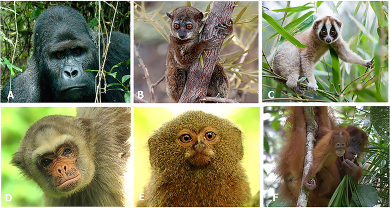
Primate diversity! (Fig. 10 in Estrada et al. 2018)
Primates are important to people and forests: they are humans closest living relatives and have both cultural and ecological significance. research on primates can tell us about our own evolution and about the health of tropical ecosystems!
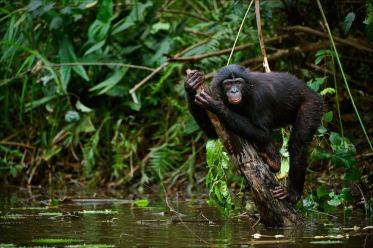
There is a huge diversity of primate species: 504 species.
Almost all primates live in the tropics.
75% of primate species are facing declining populations and extinction.
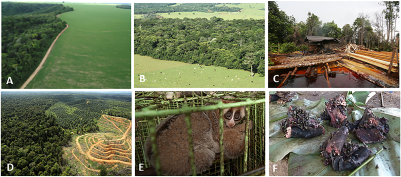
These declines are driven by human activities on local and global scales:
Deforestation for agriculture, development, logging, mining, etc.
Hunting for bushmeat and the illegal pet trade
Climatechange and disease transmission
Human populations are increasingly overlapping with primate populations.
Need more sustainable human development in the tropics.
Effort should be focused on creating and maintaining protected areas that are left.
Everyone must raise global scientific/public awareness of the plight of primates!
Primates in the tropics face a number of human-related threats (Fig 4 in Estrada et al. 2018)
Half of all Bornean orangutans have been affected by natural resource extraction
An estimated 100,000 orangutans were lost in the last 16 years
Habitat loss causes most severe declines
Hunting plays a much bigger role in orangutan decline than previously thought
Big picture: There are A LOT of factors contributing to the RAPID decline of primates that we are seeing across the tropics. One of the most universal problems facing primates is deforestation – driven by rural population growth and agricultural expansion as well as worldwide demand for forest resources. Indonesia has one of the highest rates of deforestation in the world and, as a result, orangutan populations have declined faster than those of almost any other primate species. Indonesia’s oil-palm production has been the main scapegoat for the country’s deforestation but there are, in fact, many drivers of orangutan loss. For all primates, including orangutans, conservation will depend heavily on local sustainable development, the preservation of protected habitat, and more widespread, global awareness.
Tuanan has one of the highest densities of orangutans in all of Borneo. It is not, however, a strictly protected area; Tuanan lies within the Mawas Conservation Area where multiple organizations collaborate to monitor this important peat-land ecosystem. The establishment and ongoing presence of the Tuanan Orangutan Research Project helps ensure the preservation of the Tuanan forest and aids in local development and education. Tuanan, however, encompasses only a small proportion of the much larger, at-risk orangutan habitat. Without proper governmental protection, human pressures will continue to drive orangutans toward extinction.
Unlike in many other primate host countries, the Indonesian government has acknowledged the importance of and committed to primate conservation through stricter regulations on palm-oil production. Simply by reading this, YOU play a key role in the ‘global public aweness‘ solution listed by all the above articles as essential for primate conservation! ACT: donate to a conservation organization you care about, commit to buying palm-oil-free foods when you go shopping (see Palm Oil Blog Post), or simply share this information with your friends and family!
TORP is about more than just research…In addition to collecting ecological data on one of the largest remaining populations of wild Bornean orangutans…CORE is dedicated to the livelihoods and education of the local people of Tuanan…Thank you for reading from all of us at the Tuanan Orangutan Research Project!
PHOTO CITATIONS:
A. Estrada, P. A. Garber, A. B. Rylands, C. Roos, E. Fernandez-Duque, A. Di Fiore, K. A.-I. Nekaris, V. Nijman, E. W. Heymann, J. E. Lambert, F. Rovero, C. Barelli, J. M. Setchell, T. R. Gillespie, R. A. Mittermeier, L. V. Arregoitia, M. de Guinea, S. Gouveia, R. Dobrovolski, S. Shanee, N. Shanee, S. A. Boyle, A. Fuentes, K. C. MacKinnon, K. R. Amato, A. L. S. Meyer, S. Wich, R. W. Sussman, R. Pan, I. Kone, B. Li, Impending extinction crisis of the world’s primates: Why primates matter. Sci. Adv. 3, e1600946 (2017). doi:10.1126/sciadv.1600946pmid:28116351
Estrada A, Garber PA, Mittermeier RA, Wich S, Gouveia S, Dobrovolski R, Nekaris KAI, Nijman V, Rylands AB, Maisels F, Williamson EA, Bicca-Marques J, Fuentes A, Jerusalinsky L, Johnson S, Rodrigues de Melo F, Oliveira L, Schwitzer C, Roos C, Cheyne SM, Martins Kierulff MC, Raharivololona B, Talebi M, Ratsimbazafy J, Supriatna J, Boonratana R, Wedana M, Setiawan A. (2018) Primates in peril: the significance of Brazil, Madagascar, Indonesia and the Democratic Republic of the Congo for global primate conservation. PeerJ6:e4869https://doi.org/10.7717/peerj.4869
World Ape Fund. (2015) Fast Ape Facts. http://www.worldapefund.org/fast-ape-facts/
 Big picture: There are A LOT of factors contributing to the RAPID decline of primates that we are seeing across the tropics. One of the most universal problems facing primates is deforestation – driven by rural population growth and agricultural expansion as well as worldwide demand for forest resources. Indonesia has one of the highest rates of deforestation in the world and, as a result, orangutan populations have declined faster than those of almost any other primate species. Indonesia’s oil-palm production has been the main scapegoat for the country’s deforestation but there are, in fact, many drivers of orangutan loss. For all primates, including orangutans, conservation will depend heavily on local sustainable development, the preservation of protected habitat, and more widespread, global awareness.