Ever wonder what it is like to conduct research in the peat swamp forests of Borneo? Meet the three new researchers at Tuanan: Sophia, Shaylyn, and Ethan, who have traveled from around the world to collect data for a year as student researchers at Tuanan. Here is their story and an introduction to what they are researching about the Tuanan orangutans!
We made it! This is Sophia Palia, Shaylyn Austin, and Ethan Harris and we are the newest student researchers at the Tuanan Orangutan Research Station! We arrived at camp a little over two months ago and wanted to share our experience here so far.
Here’s a little bit about each of us and why we came to Tuanan:
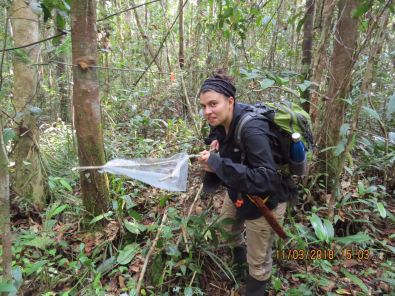
My name’s Sophia Palia and I’m a recent graduate of The College of William & Mary in Williamsburg, VA. I graduated with a Biology major and am interested in behavioral ecology and conservation. I came to Tuanan because I’ve only ever worked with captive animals and I wanted field research experience. The Tuanan Orangutan Research Project seemed like fascinating and important work that combined my interests of both ecology and conservation while allowing me to
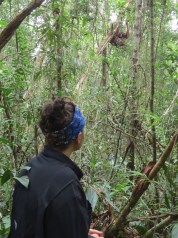
explore another culture and language. I will be here for a year working with Dr. Erin Vogel on her long-term project collecting nutritional and behavioral data as well as urine samples. My project specifically looks at the relationship between nutrition, oxidative stress, and immunity in Bornean orangutans (Pongo pygmaeus wurmbii). My time here so far has been challenging but so rewarding and has helped me discover my love for tropical ecology which I hope to pursue in my career.


Hi, my name is Shaylyn Austin, and I’m working at the Tuanan Orangutan Research Station for a year, assisting in data collection for Dr. Vogel’s long-term Nutritional immunology, energetics and habitat quality in Bornean orangutans project. This project seeks to understand how orangutans regulate their nutritional intake based on available food sources in their habitat, and then, how their nutritional strategies affect their health. I graduated this past Spring from the University of Michigan with a B.S. from Program in the Environment, where I focused my studies on the intersection of conservation biology, human ecology, and environmental policy. When I studied abroad in Indonesia three years ago, I was captivated by the rich cultural and ecological diversity of the country. I’ve been itching to get back ever since. Joining the Tuanan team was the perfect opportunity for me to pursue my interest in tropical ecology and build upon my Indonesian language skills, while gaining valuable field work experience. After two months, I feel like I’m settling in to the rhythm of 12-hour days (on average) in the forest. I’m grateful for the opportunity to study Bornean orangutans in their home and I’m psyched for the many months to come.
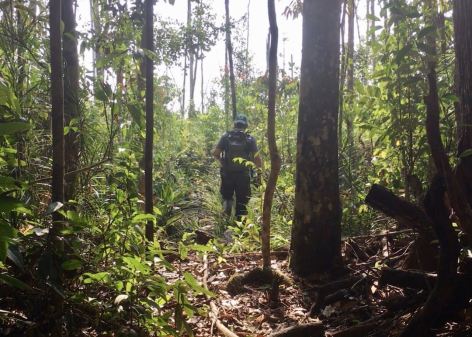
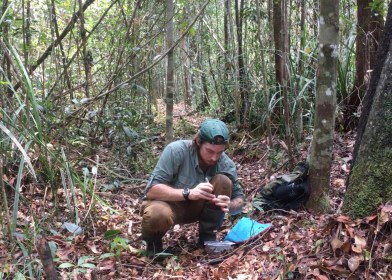
My name is Ethan Harris. I’ll be working with Dr. Vogel on her long-term project but I’ll also be working with her PhD student, Rebecca Brittain, on her gut microbiome project. This means that in addition to nutritional and behavioral data, I get the privilege of hunting for poop. By way of fecal samples we aim to analyze the microbial communities of the gastrointestinal tracts of wild Bornean orangutans; a first for gut microbe science. It’s an ambitious project and I’m thrilled to be a part of it as well as the enduring work of Dr. Vogel here at Camp Tuanan. Recently graduated from Central Michigan University and freed of a six-year contract with the Air Force, I came to Tuanan with desires both personal and professional. Professionally, I wanted research experience; personally, I wanted adventure. Having been here a couple months now, I can assuredly say I’ve found both!
Even though we are all coming from different backgrounds, we all share a common interest: ORANGUTANS!
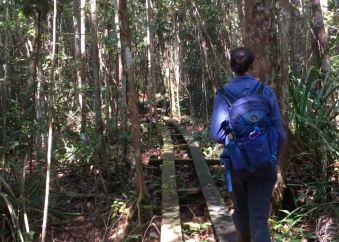
So, what do we do here at Tuanan? We collect behavioral and nutritional data as well as fecal and urine samples. To accomplish this, we work with the Indonesian team of research assistants here at camp and conduct nest-to-nest individual focal follows of orangutans. We have search and follow days. On search days we go into the forest at 7am and basically try to find orangutans. We move along the transect system of our study area and listen for long calls, leaves rustling, and the sounds of orangutans munching on fruit. If we find an orangutan, we start collecting data and follow it to nest.
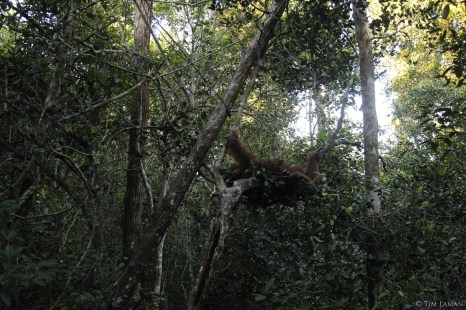
Then, on follow days, we head into the forest around 4am and wait for the orangutan to wake up and urinate. We catch that liquid gold in plastic bags on a stick. We collect 2-minute focal data. So essentially, every 2 minutes we record what the focal orangutan is doing, whether that be resting, moving, eating, or another behavior. Since our projects focus on nutrition, we mainly want to see what the orangutans are eating and for how long.
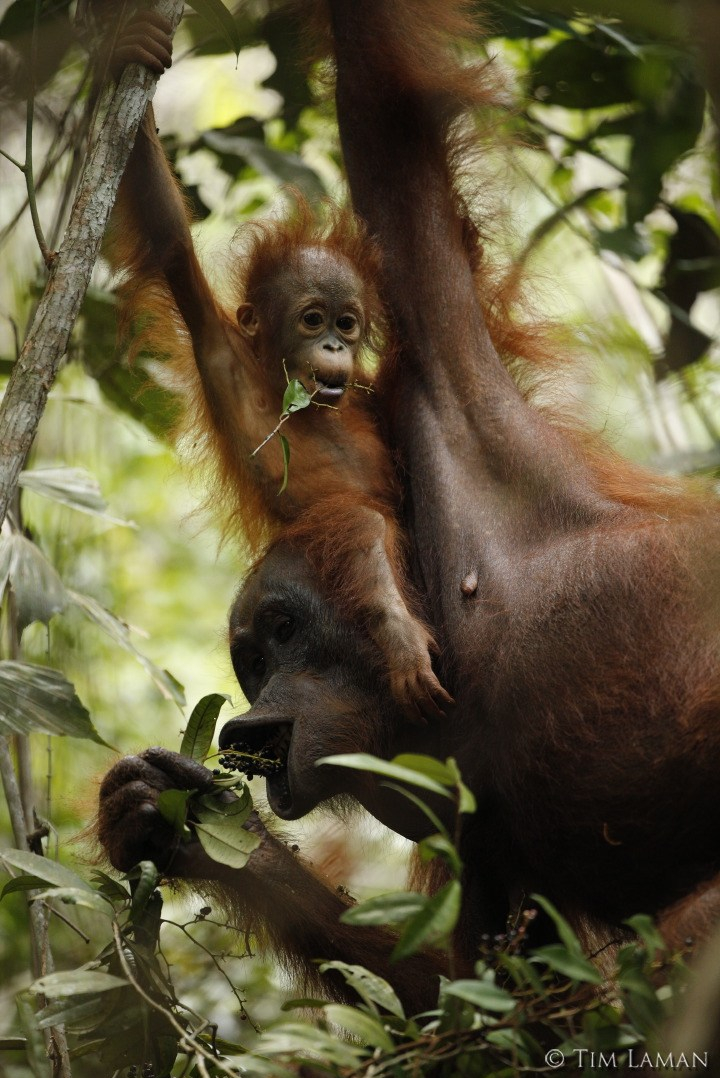
This way we can calculate how much energy they are consuming and can study the fecal and urine samples in conjunction with this nutritional data. We also take GPS measurements every 30 minutes, record long calls, and take pictures of our focal orangutans.
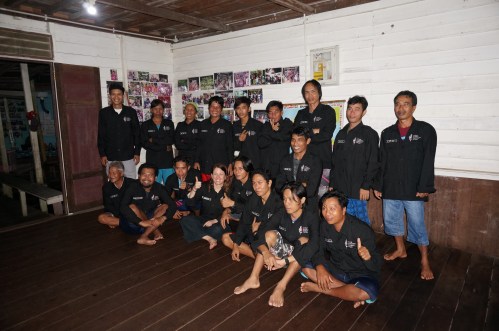
The team here has been really great, helping us learn data collection, phenology, and the Indonesian language. When we are not working, we enjoy spending time in Terapung, the village near camp where we often go to play volleyball in the afternoon and show off our dance skills at 6am Zumba. So far, this research experience has been an incredible learning experience and we look forward to the months to come.

